

St. John Paul II School students reach for the stars through NASA program
Originally posted on www.anchornews.org
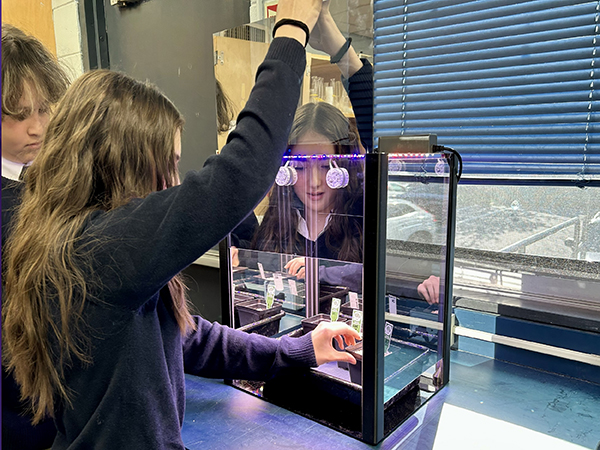
Seventh-grade student Bella Bliss returns her plant to the growing chamber used during the trials. This growing chamber mimics the one currently being used on the International Space Station.
HYANNIS — While the world watches NASA prepare for future deep space missions, seventh-grade students at St. John Paul II School are contributing to that effort from their science classroom on Cape Cod.
Students at the school are participating in Growing Beyond Earth, a federally funded science initiative led by the Fairchild Tropical Botanic Garden in partnership with NASA. The program allows middle and high school students across the country to conduct hands-on plant research that may help address one of the major challenges of long-duration space travel: how to sustainably grow fresh food for astronauts.
Using specialized plant habitats modeled after the Vegetable Production System, known as “Veggie,” currently aboard the International Space Station, students study how plants grow in space-like conditions. Their research is designed to support NASA scientists as astronauts prepare for longer journeys into deep space, including future Artemis missions.
St. John Paul II School is one of approximately 500 schools nationwide participating in the program and one of only three schools in Massachusetts selected to take part. Students collect data on plant growth and submit their findings to NASA’s Space Crop Production Team at Kennedy Space Center.
“Through Growing Beyond Earth, JPII students are not only learning about plant biology, they are helping shape the future of human space travel,” said science teacher Meaghan Wile. “The opportunity to contribute to NASA scientific research from the classroom opens an entire universe to our students.”
Wile said the experience has helped students recognize how classroom learning can have real-world applications.
“We’ve been so fortunate to participate in Growing Beyond Earth,” she said. “It’s allowed our students to see that what they learn in the classroom has implications in the world around them, and especially to their future.”
The experiments, developed in coordination with NASA’s Science Mission Directorate, allow students to test plant varieties and growing techniques using hardware modeled after systems currently operating aboard the International Space Station. Their findings contribute to ongoing research focused on developing sustainable food sources for astronauts traveling far beyond Earth.
Paula Daly, assistant head of school at the Preparatory Division, said the program gives students a rare opportunity to participate in authentic scientific discovery.
“This program provides an extraordinary opportunity for students to engage in authentic scientific research,” Daly said. “It empowers them to think creatively, ask meaningful questions, and see themselves as contributors to the future of science and exploration.”
Beyond scientific knowledge, Wile said students developed important collaborative and communication skills throughout the project.
“Our students have learned important skills while participating in this program,” she said. “They need to collaborate, make decisions, and communicate with their peers in order to successfully follow the protocols we were given from the Growing Beyond Earth program leaders.”
Earlier this spring, six seventh-grade students presented their research findings at the Growing Beyond Earth Symposium, where they answered questions from judges that included NASA scientists.
“The students were professional and knowledgeable,” Wile said. “They were so excited to be able to present to actual scientists that work at NASA.”
As NASA continues preparing for the next era of human space exploration, the work being done in classrooms like those at St. John Paul II School may one day help astronauts harvest fresh food millions of miles from Earth.